Best Website Builder for Contractors vs a Web Designer for Contractors: What to Look For, Red Flags, and Real Cost Tradeoffs
If you run a contracting business, your website has a job to do. It should help a homeowner decide, quickly, that you are credible, local, responsive, and worth contacting. That is the whole game. Not awards. Not fancy animations. Not a homepage that takes ten seconds to load because someone got carried away.
The real choice most contractors face is simpler than it sounds. Do you use the best website builder for contractors and do it yourself, or do you hire a web designer for contractors and hand the work off? There is a third path too, and for a lot of small businesses it is the most practical one: a managed website for small business, where design, hosting, updates, and support are bundled into one monthly service.
Each option can work. Each option can also waste money if it does not match the stage of your business, your available time, and the kind of jobs you want to attract.
I have seen contractors spend too little and stay stuck with a site that looks like a placeholder. I have also seen them spend far too much on a custom build that did not produce better leads than a simpler site would have. The smartest decision usually comes down to fit, not prestige.
Start with the question most contractors actually ask
The first question is almost always, how much does a contractor website cost?
That depends on who is building it, how custom it needs to be, and how much ongoing help you want after launch.
At the lowest end, DIY builders can start around the cost of a modest monthly software subscription, roughly the price range many business website plans begin at, with some starting around $17 per month. That can be a perfectly reasonable entry point if your needs are basic. A simple site with a homepage, service pages, a gallery, your service area, and a contact form does not always require a large investment.
Once you hire a freelancer, the numbers usually jump into the thousands. A recent industry breakdown put freelancer-built websites roughly in the $2,000 to $10,000 and up range. Agencies typically cost more, sometimes much more, with custom projects often landing anywhere from $15,000 to $50,000 and beyond.
That spread tells you something important. Website pricing is not just about pages. It reflects who is doing strategy, who writes the copy, who sources the visuals, who sets up forms, who handles revisions, and who sticks around after launch when something breaks or needs to change.
If you only compare sticker price, you will miss the real tradeoff. A cheaper website that never gets finished is expensive. A custom website that takes months and still does not clearly explain your services is expensive. A subscription that saves you twenty hours a month may be a bargain, even if the monthly cost looks higher than hosting a DIY site yourself.
What a website builder gets right for contractors
There is a reason drag-and-drop builders are popular. They are fast, accessible, and cheap compared with hiring a professional team. For a newer contractor, or a small operation that mostly needs a credible web presence, they can be enough.
A platform template is often the fastest route from no website to a live website. If your goals are straightforward, you can put something together in hours rather than months. That matters when you are busy in the field and need calls coming in now, not after a long design process.
For a simple business, the builder route can work especially well if you need:

- A clean homepage with your core services and service area
- A photo gallery of recent work
- A contact form and click-to-call phone number
- Basic service pages for search visibility
- A low upfront cost while you prove demand
That is the good side of DIY. The part people do not always say out loud is that a builder only saves money if you can finish the job and maintain it. Plenty of contractors start with strong intentions, choose a template on a Sunday night, then stall when it is time to write copy, resize images, organize service pages, and keep the site updated.
The best website builder for contractors is not necessarily the one with the most features. It is the one that lets you publish a strong, trustworthy site without turning you into a part-time website manager.
Where DIY starts to crack
DIY becomes harder the moment your business has any complexity.
A home remodeling website design, for example, usually needs more than a generic homepage and a short About page. You may need distinct service pages for kitchens, bathrooms, additions, and whole-home renovations. You may want project galleries organized by type of work. You may need to explain your process, your lead times, and the kinds of projects you do not take. That is still not wildly complex, but it is more involved than plugging text into a template.
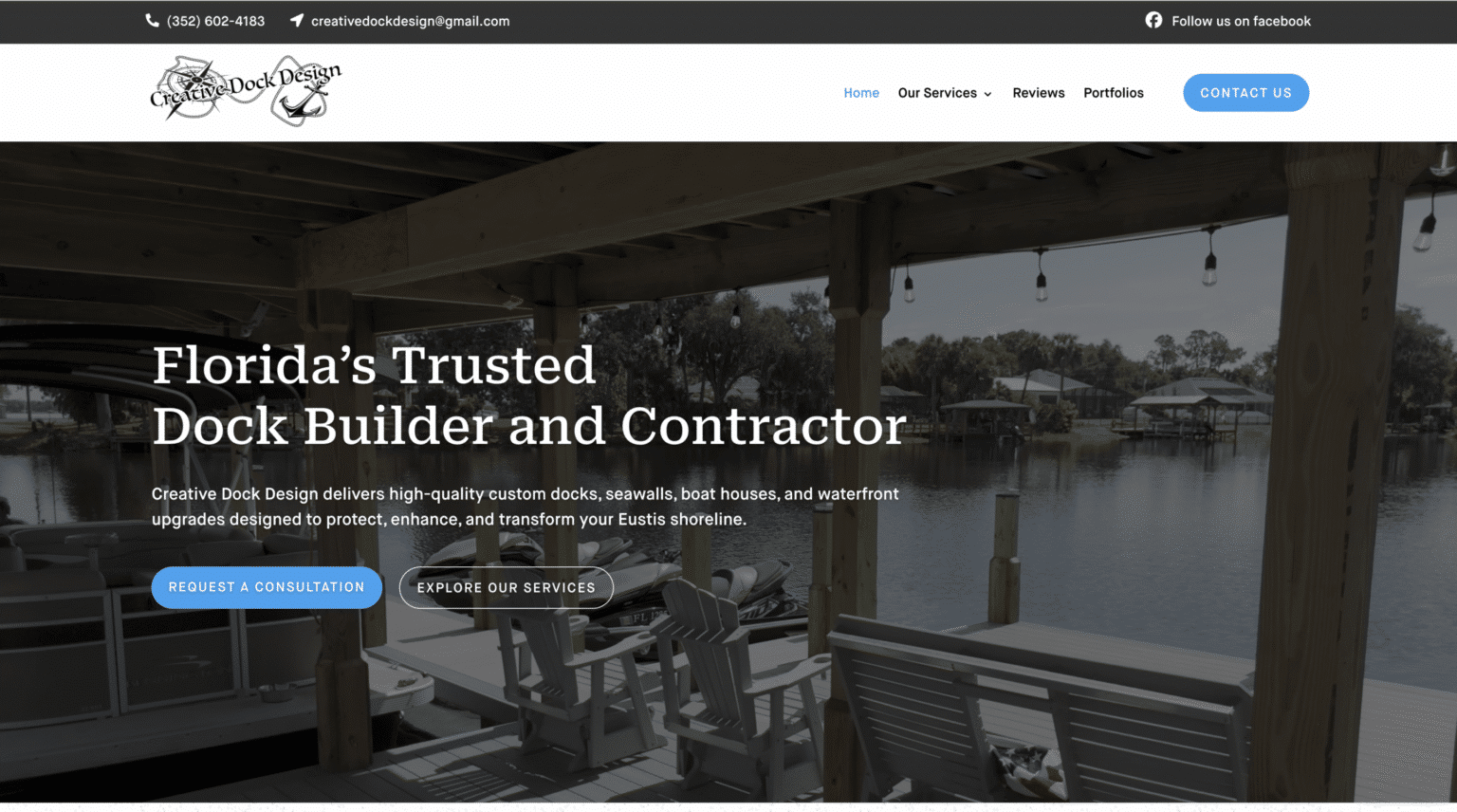
The same problem shows up in niche trades. Pool screen enclosure website design has its own visual priorities. Concrete coating website design and epoxy flooring website design often depend heavily on before-and-after imagery and clear explanations of systems, surfaces, and use cases. A dock builder website design may need to speak to both residential and commercial clients, or explain waterfront-specific services. Mold remediation website design has a trust problem to solve, because the customer is often anxious and wants clarity fast.
A builder can technically handle those pages, but the challenge is not whether the software allows it. The challenge is whether the final site tells the right story, in the right order, with the right emphasis.

That is where many contractor sites fall apart. Not from lack of technology, but from weak messaging. They say too little, or they say everything at once. They bury the service area. They use stock images that do not match the work. They make the visitor hunt for basic answers.
contractor web design companyWhat a web designer for contractors is really selling
When you hire a web designer for contractors, you are not just paying for someone to place boxes on a page. At least, you should not be.
You are paying for judgment. What should go on the homepage. Which services deserve their own pages. What photos should lead. How the site should guide a homeowner from curiosity to contact. Whether the design feels polished without becoming generic. Whether someone has thought through mobile layout, readability, forms, trust signals, and the practical flow of a lead.
That is why professional builds cost more. There is usually strategy involved, not just production. Discovery and planning alone can take one to three weeks before the visible work even starts. On larger custom projects, the full timeline can stretch to one to six months, especially when content creation, revisions, and advanced functionality are involved.
That timeline is not always a problem. If you are established, rebranding, expanding into new service lines, or replacing a site that actively hurts conversions, the extra time can be worth it. A contractor website redesign should improve business performance, not simply make the site look newer.
Still, hiring a designer is not automatically the better move. It depends on what kind of designer you hire.
A freelancer may be affordable compared with an agency, but the quality range is wide. Some are excellent. Some are really selling polished mockups and hoping you will not ask hard questions about support after launch. Agencies can bring a stronger process, but sometimes they overbuild, especially for local service businesses that do not need enterprise-level complexity.
The middle ground more contractors should consider
This is where the managed website for small business model becomes interesting.
With a managed website, you are usually not buying software and then figuring the rest out yourself. You are buying an ongoing service. Hosting, security, backups, updates, and support are bundled into a monthly arrangement. In practical terms, that means you are not the one staying up late after a long job site day trying to figure out whether a plugin update broke your contact form.
For a lot of contractors, that is the real value. Not just launch, but maintenance.
Managed hosting generally means the provider handles technical upkeep such as backups, security, performance-related settings, and server configuration. Depending on the provider, the monthly service may also include edits and general support. You give up some server-level control, but in exchange you remove a lot of maintenance burden.
That trade can make a lot of sense if your business needs a professional site but you do not want to become your own webmaster. Some managed providers position the offer as a designed-and-supported website subscription rather than a one-time build. One example in the contractor space is Scalable Websites, which offers professionally designed contractor websites on a monthly subscription with hosting, security, unlimited updates, and a dedicated project manager included. It is based in Houston and serves contractors nationwide, with most sites launching in days.
That kind of offer is not for everyone. If you want total control over every technical layer, a managed service may feel restrictive. If you are the type who enjoys tweaking the site personally, you may prefer direct ownership of the build environment. But if your priority is getting a site live and keeping it current without chasing vendors, it can be a strong fit.
Ownership matters more than many contractors realize
This is one of those issues that only becomes urgent after something goes wrong.
Some contractors assume that because they paid for a site, they automatically own every part of it. Sometimes that is true. Sometimes it is not. The answer depends on the agreement.
If you hire a freelancer or agency, ask exactly what you own. The design? The copy? The domain access? The site files? The images? The platform account? If you use a subscription-based managed model, ask what happens if you cancel. Do you lose the site entirely, or can you export some or all of it? There is no universal answer, which is why the question matters.
This is not a legal technicality. It affects leverage. A contractor who cannot access the domain, update core business information, or move providers easily is in a weak position. A contractor who understands the setup can make cleaner business decisions later.
Red flags that deserve immediate skepticism
You do not need to be a technical expert to spot a bad fit. You just need to listen for vagueness, pressure, or gaps in accountability.
Here are the red flags I would take seriously:
- Pricing is unclear, or the provider avoids explaining what is included
- Nobody can tell you who handles updates, backups, security, and support after launch
- The seller talks mostly about design style, but very little about leads, messaging, or service pages
- Ownership of the site, content, or domain is fuzzy
- Edits after launch are treated like a mystery or an expensive surprise
A good provider should be able to answer those points plainly. Not in jargon. Not with a sales dodge. Plainly.
If someone cannot explain how support works, assume support will be weak. If someone cannot explain what happens after launch, assume you are buying a handoff, not a solution.
Different trades need different website decisions
One reason generic website advice often fails contractors is that not all contractor sites do the same job.
A flooring contractor website design often lives or dies on visuals. Customers want to see finishes, patterns, transitions, room types, and proof of clean workmanship. Epoxy flooring website design and concrete coating website design may need to explain durability, surface prep, and suitable applications, while still making the visual transformation obvious.
Mold remediation website design has a different burden. The customer is often dealing with urgency, uncertainty, and trust concerns. The site must feel reassuring and competent. Clear explanations matter. Easy contact matters. Technical polish matters less than clarity and confidence.
Home remodeling website design tends to need depth. Visitors often browse longer, compare options, and scrutinize project photos more carefully. They may want to understand process, scope, and fit before making contact.
A dock builder website design may need to accommodate location-specific concerns and different types of structures or client needs. Pool screen enclosure website design may depend on regional demand patterns and highly visual proof of craftsmanship.
The more specialized the service, the less helpful a generic one-size-fits-all contractor template becomes. That does not automatically mean you need a high-ticket custom build. It does mean your site should be shaped around how customers buy that particular service.
The hidden cost of the wrong website path
Contractors sometimes focus so hard on upfront spend that they ignore operational cost.
A cheap DIY website can cost you in lost evenings, delayed launch, neglected updates, and weak presentation. A high-end agency website can cost you in long delays, overengineering, and money tied up in features your customers do not care about. A managed subscription can cost you in reduced technical control, or in an ongoing monthly fee that feels unnecessary if you rarely need support.
The real cost is not the invoice. It is the mismatch.
I have seen contractors with simple local service businesses wait months for custom sites when they could have been live quickly on a managed plan or polished builder setup. I have also seen established remodeling firms try to squeeze their brand into a bargain template and end up with a site that undersold the quality of the work.
The right choice depends on the maturity of the business and the job the website needs to perform over the next twelve to twenty-four months, not just next week.
When a contractor website redesign is worth it
A redesign should solve a business problem. If it does not, it is decoration.
Sometimes the problem is obvious. The site looks outdated. It is hard to use on a phone. It does not reflect the kind of projects you now want. You have added services, changed markets, or rebranded. Maybe the site gets traffic but too few calls. Maybe the site exists, but nobody in the company wants to send prospects to it.
Those are valid reasons to revisit the platform, the structure, and the message.
A contractor website redesign is especially worth considering when the old site no longer matches the business you are trying to become. A small shop that used to take anything may now want larger-ticket work. A flooring company may want to emphasize premium installations over commodity jobs. A remodeler may want fewer tire-kickers and more qualified leads. The site should help filter for that.
Redesigning just because the homepage feels stale is usually not enough. Redesign because the current site is underperforming or misrepresenting the business.
How to choose without getting trapped in jargon
A smart decision usually comes from asking practical questions, not technical ones.
Ask how long the process takes. Simple builder-based sites can go live quickly, while custom builds can take weeks or months. Ask who is writing the content. Ask how revisions work. Ask what happens after launch if you need to add a new service page or change photos. Ask whether hosting, security, backups, and support are included. Ask what you own. Ask how easy it is to get help.
Those questions reveal more than a design portfolio ever will.
Here is the simplest way I frame it for contractors:
If your needs are basic, your budget is tight, and you are willing to manage the site yourself, a builder may be enough.
If your business is more established, your services are more nuanced, or your time is too valuable to spend on design and upkeep, hiring a web designer for contractors or using a managed website for small business makes more sense.
If you want a middle path, one monthly price, professional presentation, and ongoing support without a large upfront project fee, a managed option deserves a hard look.
A final reality check on value
The best website for a contractor is not the most expensive one, and it is not the one with the most features. It is the one that gets built, communicates trust fast, reflects the real quality of the work, and stays maintained over time.
That sounds obvious, but it eliminates a lot of bad decisions.
For many local contractors, the winning site is not particularly flashy. It is clear. It loads fast. It shows real work. It makes contact easy. It answers the questions a homeowner has before calling. It is kept current. And when the business evolves, the website evolves with it.
That is why this decision should be made less like a shopping trip and more like a business investment. Look past the demo. Look past the pretty mockups. Look at the support model, the speed to launch, the ownership terms, the maintenance burden, and the total cost over time.
Do that, and the choice between the best website builder for contractors, a web designer for contractors, or a managed website for small business gets much clearer. The right answer is the one that gives your business a site you will actually use, actually maintain, and actually trust to represent you when you are out on the job and a new customer is deciding whether to call.